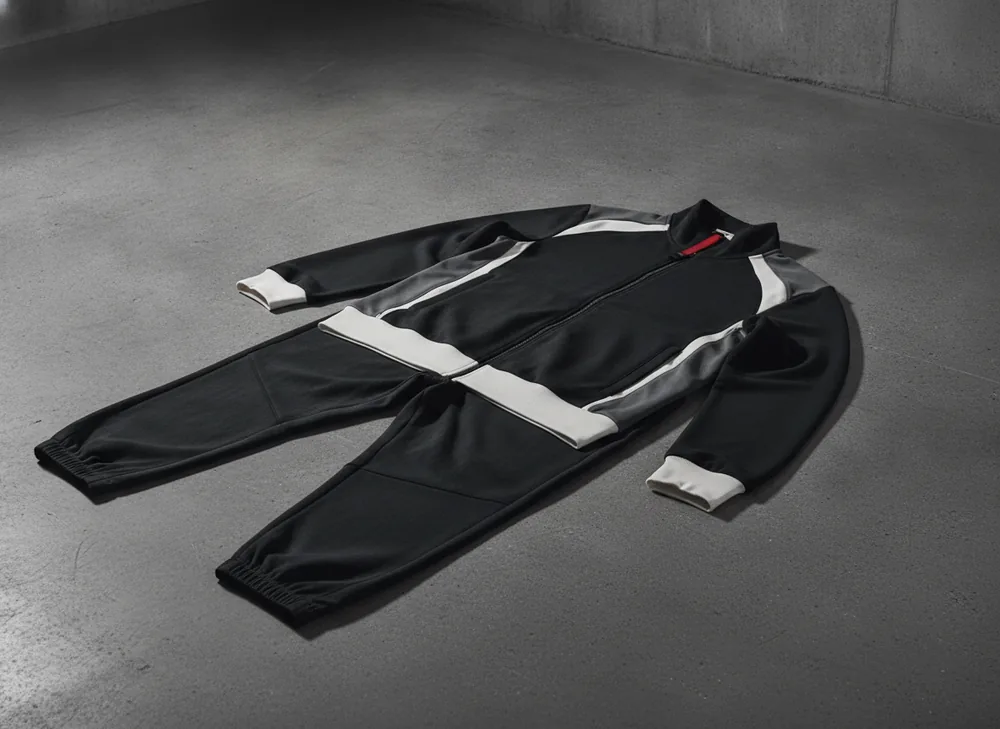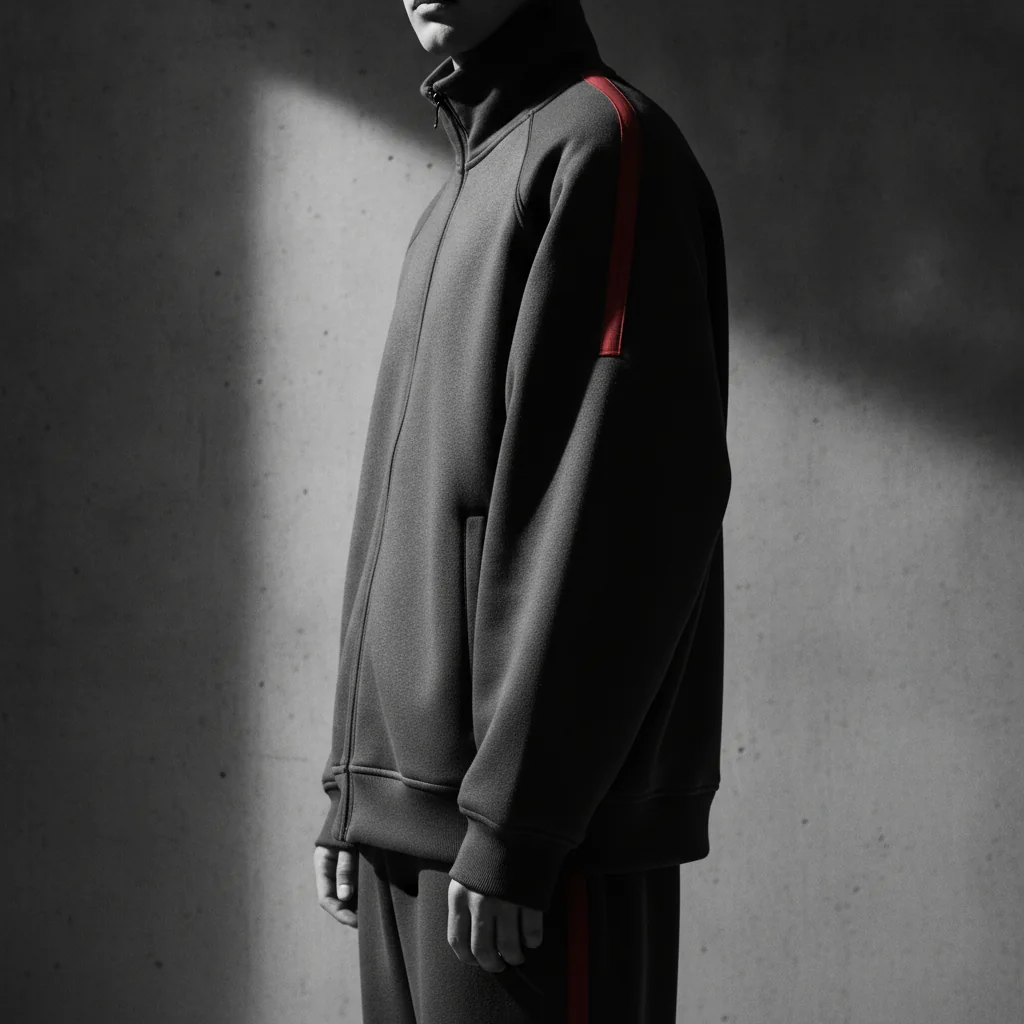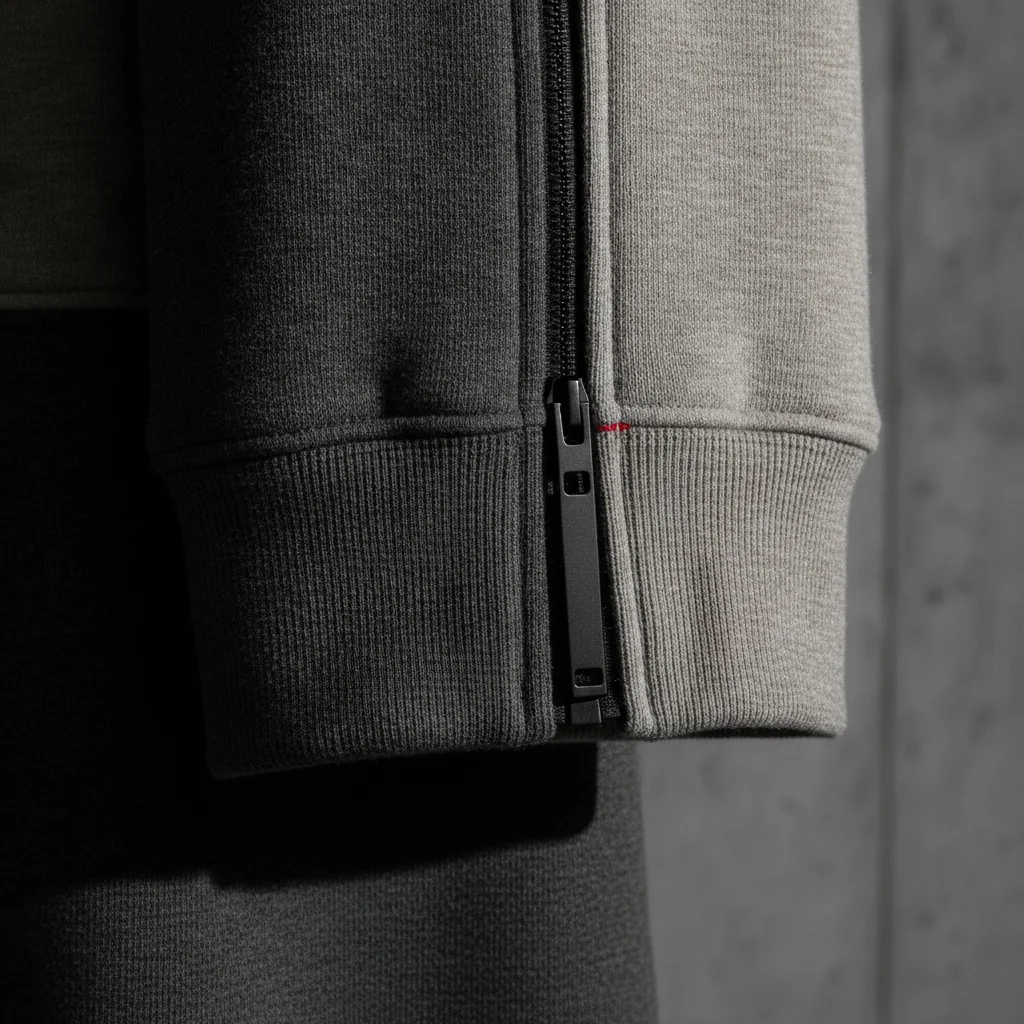
Wholesale tracksuits are pre-made stock sets you brand with a label; custom tracksuits are built to your own fabric, fit, and design spec from the pattern up. For a brand that wants a proprietary product and control over fabric weight, fit, and decoration, custom manufacturing is the stronger long-term investment – wholesale suits a fast, low-commitment test of an idea before scaling.
The choice is not about one option being superior in each case – it is about what stage your brand is at and what you are trying to prove. This page breaks down what each route actually gives you, where the costs land over time, and how to decide which one fits your next drop.
Wholesale Tracksuits
Stock fleece sets from a catalog, sourced in fixed fits and fabric weights, decorated with your label and print. Fast to source, low commitment, but shared with each other buyer of the same catalog number.
Custom Tracksuits
Built to your own tech pack – your fabric weight, fit, trims, and decoration – sampled and approved before bulk. Proprietary to your brand, held consistent across reorders.
What Wholesale Tracksuits Actually Are
A wholesale tracksuit is a set already manufactured to a distributor’s catalog spec – fixed fabric weight, fixed fit, fixed trims – that you buy in bulk and decorate with your own print or embroidery and label. The garment itself is not yours to change; you are choosing from a menu of existing styles rather than commissioning a new one. Minimums on wholesale stock are often set by the distributor’s inventory levels rather than a manufacturing floor, and can run lower or higher than a custom program depending on what is in stock.
Because the base garment is shared, any brand that sources from the same distributor can end up decorating the identical set you are selling – same fabric weight, same cut, same trims, with a different logo on the chest. That isthe trade-off at the center of the wholesale route: speed and low upfront commitment in exchange for a product that is not exclusively yours.
What Custom Tracksuits Change
A custom tracksuit is built from your tech pack: you set the fabric weight and composition, the fit and silhouette, the trims, and the decoration, and the factory produces a pre-production sample for your approval before bulk cutting starts. Nothing about the garment is shared with another brand’s catalog order – the fabric lot, the pattern grading, and the finish are specced to your brief and held consistent on each reorder.
This is what makes a custom tracksuit a genuine product rather than a decorated stock item. A customer who picks up your set feels a fabric weight and a fit that exists because your brand asked for it, not because a distributor’s catalog happened to carry it this season.
Cost and MOQ Comparison Over Time
Wholesale often looks less costly on a single first order because there is no sampling cycle and stock is already produced. Custom carries an upfront sampling step and a 50-set minimum per design and colorway – a real commitment, but one that buys you a proprietary product rather than a shared catalog item. Where the math flips is on reorders: a wholesale catalog item can be discontinued or resourced by the distributor at any time, while a custom tech pack is yours indefinitely, meaning your third and fourth reorder cost the same design work as the first – none.
| Factor | Wholesale | Custom |
|---|---|---|
| Fabric and fit | Fixed by distributor | Set by your tech pack |
| Exclusivity | Shared catalog item | Proprietary to your brand |
| Sampling | None – stock as-is | Pre-production sample before bulk |
| MOQ | Set by stock levels | 50 sets per design/colorway |
| Long-term consistency | Item can be discontinued | Held to your locked tech pack |
| Reorder cost | Subject to distributor pricing | Repeats at your original spec |
Speed to Market
Wholesale wins on raw speed. Because the garment already exists in a warehouse, there is no sampling cycle to wait through – order, decorate, ship. That makes wholesale the practical choice for a brand testing whether a market wants a tracksuit product at all, or filling a short-notice merch order ahead of a launch date.
Custom takes longer on the first order because of the sample-and-approve cycle, but that time buys certainty: the fit, fabric, and colorway are confirmed on your body of customers before 50 sets are committed to production, rather than discovered after the stock has already shipped.
Brand Differentiation and Reorders
The starkest difference shows up over a brand’s second and third season. A wholesale-sourced tracksuit caps how distinct your product can look, because the underlying garment is shared with any competitor buying the same catalog number – your differentiation lives entirely in the print, which a competitor can also apply to the identical base. A custom tracksuit differentiates at the garment level: your fabric weight, your fit, your trims are not available to anyone else, so the product itself is part of your brand identity, not only the artwork on top of it.
Reorders reinforce this. A custom tech pack is a durable asset – order the same set again in six months and it should be produced to the same spec. A wholesale catalog item carries no such guarantee; distributors resource, discontinue, and change suppliers, which means a reorder can arrive on a materially different base garment than the original.
When Wholesale Still Makes Sense
Wholesale is a reasonable choice for a brand validating first-time demand for a tracksuit product line before committing design time and a 50-set minimum, for event or team merch on a tight timeline, or for a smaller operation that decorates in-house and wants a fast base to print on while the brand is still finding its product-market fit. It is a legitimate first step, not a lesser one – many labels start here and move to custom once a design proves it can sell.
When Custom Is the Right Call
Custom manufacturing earns its cost once a brand knows its silhouette, has a repeatable customer, and wants a product that cannot be replicated by a competitor sourcing the same distributor catalog. It is the correct call for a brand planning multiple drops on the same base garment, one that wants heavyweight fabric and matched trims a stock catalog cannot offer, or one building toward wholesale distribution of its own, where retail buyers expect a proprietary product rather than a decorated stock item.
A Hybrid Path: Sample Custom Before You Scale
Brands do not have to choose one route permanently. A common path is testing an idea on wholesale-sourced stock to confirm demand, then commissioning a custom tech pack once the design proves it sells – locking in the fabric weight, fit, and trims that the market has already responded to. That sequencing keeps early risk low while still building toward a proprietary product once the numbers support the sampling investment.
What a Custom Tech Pack Actually Locks In
The term custom manufacturing can sound abstract until you see what it actually fixes on paper. A tech pack for a tracksuit set records the fabric composition and GSM, the body and sleeve measurements at each size, the trim specification down to zipper tape color and drawcord finish, and the decoration placement and method for each piece. That document, not a verbal brief, is what a factory produces against and what a reorder repeats against.
A wholesale order has no equivalent document tied to your brand – the specification belongs to the distributor’s catalog, and it can change between one purchase order and the next without notice. A custom tech pack is the asset that makes a tracksuit reproducible to the same standard a year later, which is the entire basis for building repeat wholesale or retail accounts around a signature product.
How the Decision Changes as a Brand Scales
A brand placing its first order and a brand placing its fifteenth reorder are answering different questions, even when the product category is the same. A first-time buyer is mainly asking whether a tracksuit line will sell at all, which favors the lower commitment and faster turnaround of wholesale stock. A brand with three seasons of sales data is asking how to protect and grow a proven product, which favors locking that product into a custom tech pack so a competitor cannot source the identical base garment from the same distributor.
Retail buyers and larger wholesale accounts also tend to expect a proprietary product once a brand reaches a certain scale – a buyer evaluating a line for a multi-door order is typically looking for something that is not available from a dozen other labels on the same trade show floor, which is a wholesale catalog item’s structural weakness.
How Minku Supports Both Stages
We build custom tracksuits from 50 sets per design and colorway – fleece, French terry, nylon shell, or velour, with full private-label branding and in-house decoration – sampled and approved before bulk cutting starts. See what makes a build stand out on our premium custom tracksuit guide, or check the exact minimum breakdown on our tracksuit MOQ page. For the full spec menu, visit our custom tracksuit manufacturing program, or get your custom quote when you are ready to move off stock catalogs.
Wholesale vs Custom Tracksuits: Which Is Right for Your Brand? — In Detail