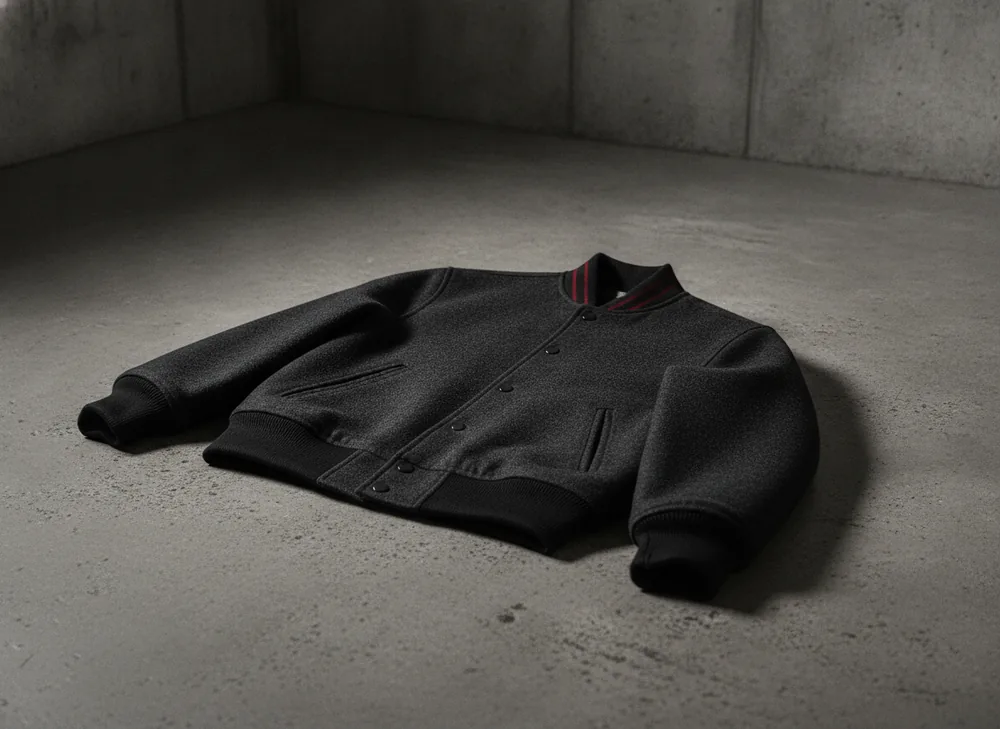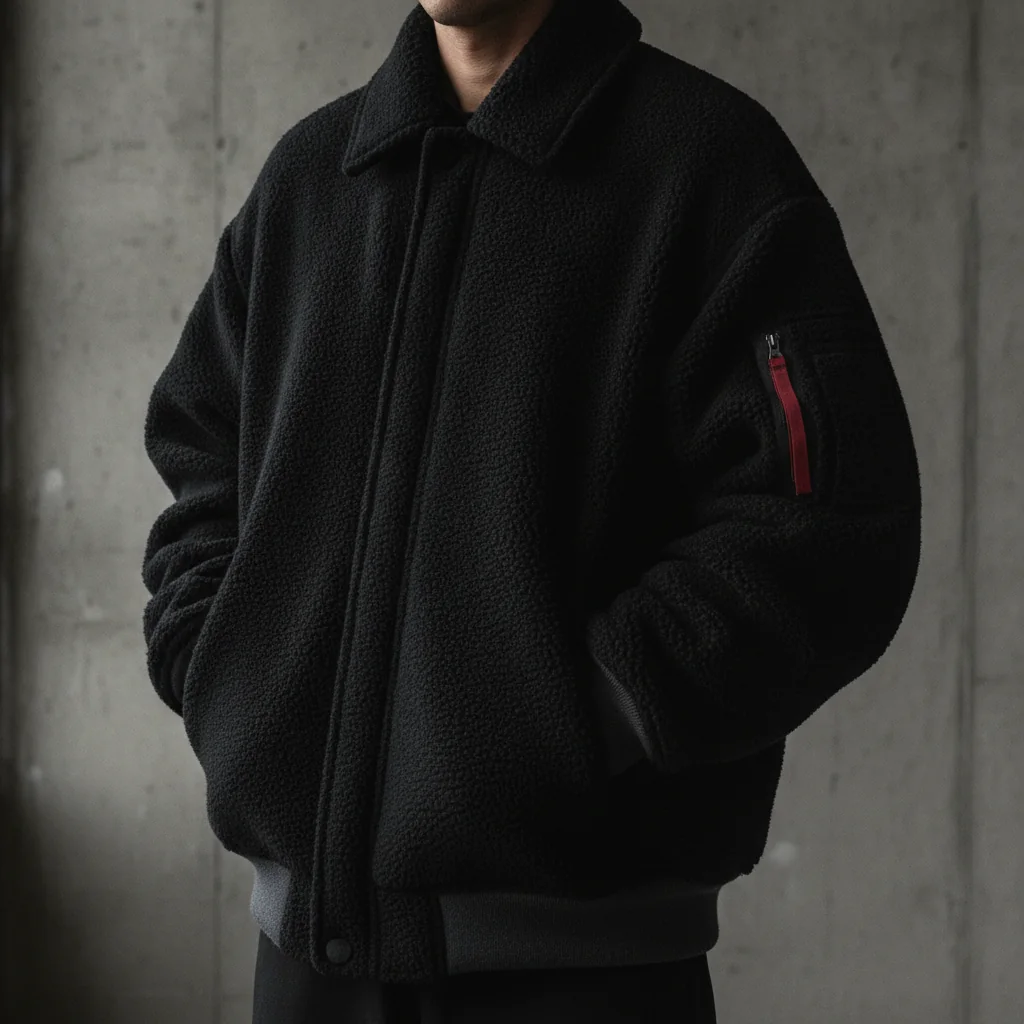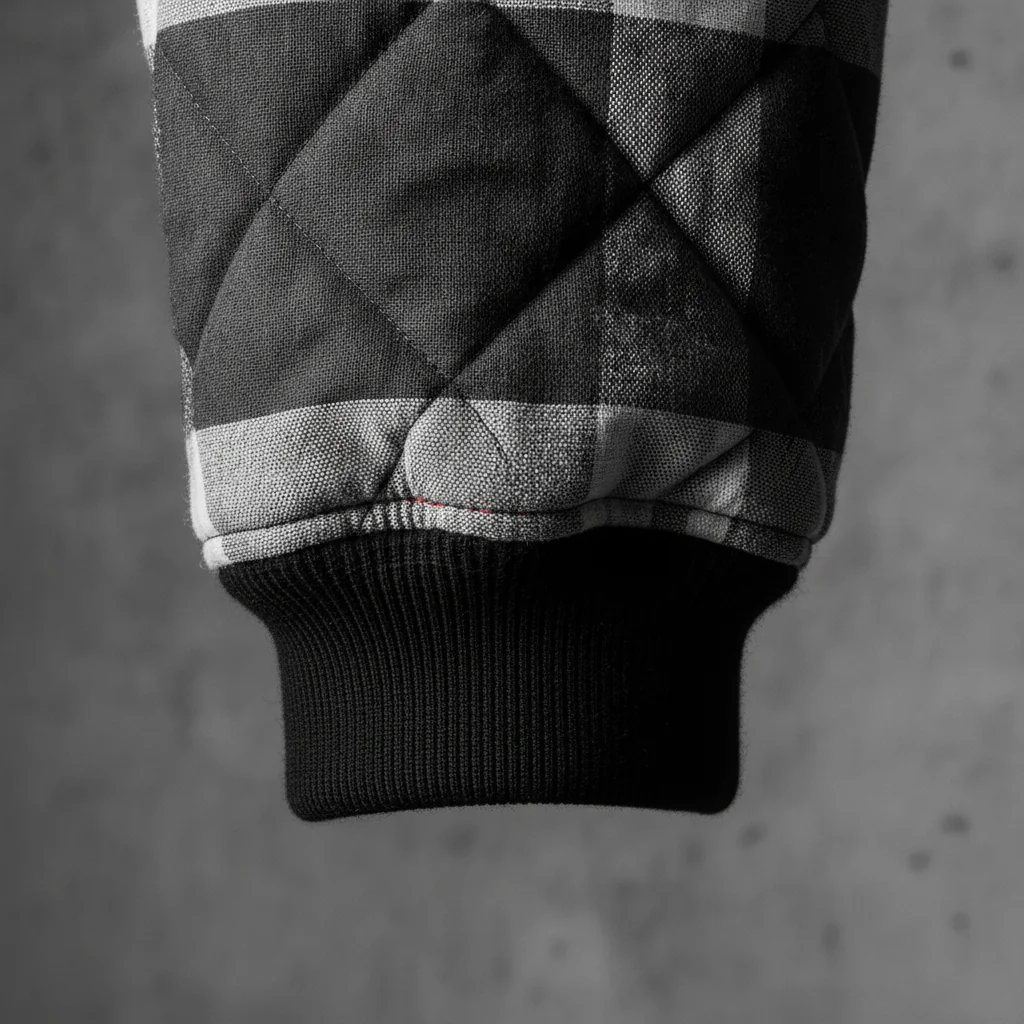
Custom jacket manufacturing costs 18 to 58 dollars per unit at factory pricing, depending on jacket style, shell fabric, and decoration method – a screen-printed cotton twill coach jacket sits at the low end, while a puffer jacket with quilted fleece insulation and embroidery sits at the high end. Minku Apparel prices each custom jacket order after reviewing your tech pack, because style, fabric weight, lining, and decoration are what move the number, not order size alone once you clear minimum order quantity (MOQ).
What Drives the Cost of a Custom Jacket
Five variables set the per-unit price on a custom jacket run: jacket style and pattern complexity, shell fabric weight and lining, decoration method and placement count, private label details (labels, woven tags, hangtags, packaging), and order quantity. A single-layer coach jacket with one screen-printed back logo is a simpler build than a lined varsity jacket with chenille letters, ribbed collar and cuffs, and a satin lining – the construction time alone changes the quote. Brands new to manufacturing often ask for one number, but a factory-direct custom jacket manufacturer like Minku Apparel builds a quote around your tech pack: fabric spec, GSM (grams per square meter – the standard measure of fabric weight), panel count, and decoration placements. Two brands ordering the same 100-piece run of hooded jackets can land 12 dollars per unit apart once one adds a full lining, contrast rib, and a puff-embroidered chest logo.
Cost by Jacket Style
Jacket styles carry different base construction costs before fabric or decoration is added, because panel count, lining, and hardware (zippers, snaps, drawcords) vary by style.
| Jacket Style | Base Construction Complexity | Typical Unit Cost Range |
|---|---|---|
| Coach jacket | Low – single layer, snap front | 18 to 28 dollars |
| Windbreaker | Low to moderate – lightweight shell, zip closure | 19 to 30 dollars |
| Bomber jacket | Moderate – ribbed collar/cuffs/hem, lining | 24 to 38 dollars |
| Denim jacket | Moderate to high – heavyweight fabric, hardware, wash finishing | 26 to 42 dollars |
| Varsity jacket | High – two-tone body, ribbed trims, chenille-ready | 30 to 48 dollars |
| Work jacket | Moderate – heavyweight canvas-style cotton, multiple pockets | 25 to 40 dollars |
| Puffer jacket | Highest – quilted insulation, multi-panel construction | 34 to 58 dollars |
These ranges reflect factory-direct pricing before shipping. A brand ordering 100 bomber jackets in one colorway with a single embroidered logo will land toward the lower half of its range; adding a second decoration placement, a printed lining, or a two-tone body pushes it toward the top.
Shell Fabric and Lining Choices
Minku Apparel builds jacket shells from heavyweight cotton twill and cotton canvas-style fabric in the 280 to 400+ GSM range, with brushed fleece or French terry used for linings, ribbed trims, and puffer-style quilted insulation panels. Heavier shell fabric costs more per yard but holds shape, print, and repeated wear better than a lightweight substitute – a real consideration for a jacket a customer expects to wear across a full season, not one drop. Lining choice affects both cost and comfort: an unlined coach jacket is the most economical build, a brushed fleece lining adds warmth and a softer hand-feel for a moderate cost increase, and full quilted fleece insulation (used in puffer-style jackets) adds the most fabric and labor cost of any lining option. Brands manufacturing for cold-weather markets – Chicago, Toronto, Munich – typically choose the heavier GSM shell and full lining; brands manufacturing a transitional-season jacket for markets like Miami or Los Angeles often choose the unlined or brushed-lining build to control cost.
Decoration Method and Its Effect on Price
Minku Apparel decorates jackets in-house with screen print, DTG (direct-to-garment printing), puff and flat embroidery, acid wash, and garment dye. Screen print is the most cost-efficient decoration for a single flat logo on a jacket back or chest panel. Flat embroidery adds a moderate per-unit cost and reads as premium on a chest logo or sleeve patch. Puff embroidery – raised, three-dimensional stitching popular on varsity-style chest logos and letters – costs more than flat embroidery because of the foam backing and extra stitch passes, but it is the decoration that reads as the most premium on a jacket. Garment dye and acid wash are finishing processes applied to the whole jacket rather than a placement print, and they add a wash-and-finish step to production – useful for brands building a faded, worn-in aesthetic on a denim or twill jacket. Combining methods (embroidered chest logo plus a screen-printed interior lining graphic, for example) is common on premium jacket drops and is priced as two separate decoration line items.
Private Label Branding and Packaging Costs
Full private label – your neck label, woven brand tag, care label, hangtag, and packaging – is standard on each Minku Apparel jacket order, not an add-on. Custom woven labels and printed hangtags carry a modest per-unit cost that scales down as order volume increases, because label runs are minimum-ordered in batches. Packaging options range from a polybag with a branded sticker seal (the most economical) to a custom printed poly mailer or a branded box for a premium unboxing experience on a higher-price-point jacket. Brands positioning a jacket as a hero product in a drop – the kind of piece a customer photographs unboxing – often invest in the branded box even though it adds cost, because the jacket itself typically retails at 80 to 220 dollars and can absorb the packaging spend without changing the buyer’s price perception.
MOQ and Per-Unit Pricing at Scale
Minku Apparel’s MOQ starts at 50 pieces per design, and per-unit jacket pricing steps down as quantity increases because fixed costs – sampling, pattern setup, decoration screen or embroidery digitizing – spread across more units. A 50-piece bomber jacket order carries the setup cost across a smaller run, so the per-unit price sits near the top of its style range. At 150 to 300 pieces, per-unit pricing typically drops 10 to 18 percent from the 50-piece price point. At 500-plus pieces, brands see a further step down, particularly on styles with higher base construction cost like puffer and varsity jackets, where the fixed setup cost becomes a smaller share of the total order value. This is why Minku Apparel encourages brands to plan a first jacket drop at 100 to 150 pieces where budget allows – the per-unit economics improve meaningfully over a 50-piece minimum run without requiring the capital commitment of a 500-piece order.
Sampling Cost Before You Commit to Bulk
Each Minku Apparel jacket order is sampled before bulk cutting begins. A pre-production sample – the physical, sewn garment built to your tech pack spec – carries its own cost separate from the bulk unit price, because it is built as a one-off with full pattern-making and construction time. Sample cost varies by jacket complexity: an unlined coach jacket sample costs less to produce than a lined varsity jacket with two-tone paneling and chenille lettering. Brands sometimes ask to skip sampling to save the up-front cost – Minku Apparel does not recommend this on jackets, because fit, lining drape, and hardware placement are harder to correct after a bulk cut than on a simpler garment like a t-shirt. The sample cost is a fraction of what a rejected 200-piece bulk order costs in re-cutting, re-shipping, and delayed launch dates.
Landed Cost: DDP Shipping to the USA, UK, and Europe
Minku Apparel ships each jacket order worldwide on a DDP (delivered duty paid) basis, meaning the freight quote already includes duty and customs clearance to your door – there is no separate customs bill arriving after the shipment lands. Air freight transit runs 5 to 8 days to the USA and UK, and 6 to 9 days to most of the European Union, so a brand can build shipping into its landed-cost math without guessing at a customs line item. On a per-unit basis, freight cost is a smaller share of the total for a heavier garment like a jacket than it is for a t-shirt, because the freight-to-value ratio improves as the unit price rises – a 40-dollar jacket absorbs a shipping cost more comfortably in its retail margin than a thin-margin basic tee would.
A Worked Example: Pricing a 150-Piece Bomber Jacket Order
Take a brand ordering 150 bomber jackets in one colorway: 320 GSM cotton twill shell, brushed fleece lining, ribbed collar/cuffs/hem, one embroidered chest logo, and a printed satin lining graphic. Base construction for a lined bomber at this fabric weight lands near 27 dollars per unit at 150-piece volume. Flat embroidery on the chest adds a set per-unit cost; the printed lining graphic adds a smaller print charge since it is a single flat placement. Private label – woven neck label, hangtag, polybag with branded sticker – adds a modest per-unit cost. All in, this brand can expect a landed factory-direct unit cost in the low-to-mid 30-dollar range before DDP freight, which is itself typically a few dollars per unit at this order size. At a 90 to 130 dollar retail price point – standard for a branded bomber jacket – this leaves healthy margin room even before further per-unit savings at higher order counts.
How Minku Apparel Prices Your Custom Jacket Run
Send Minku Apparel your jacket style, target fabric weight, decoration placements, and quantity, and the factory returns a line-itemed quote – base construction, fabric, decoration, private label, and DDP shipping broken out separately, not bundled into one number you cannot audit. A tech pack speeds this up considerably, but a clear brief with reference images works for a first quote if you have not built a formal tech pack yet. Each quoted jacket is sampled and approved before bulk cutting starts, so the price you agree to is the price you receive. Once you have a factory quote in hand, read how to price your jacket for retail, or compare wholesale vs custom jackets if you are still deciding between the two routes. Get Your Custom Quote to start your line.
How Much Does It Cost to Manufacture Custom Jackets? (2026) — In Detail