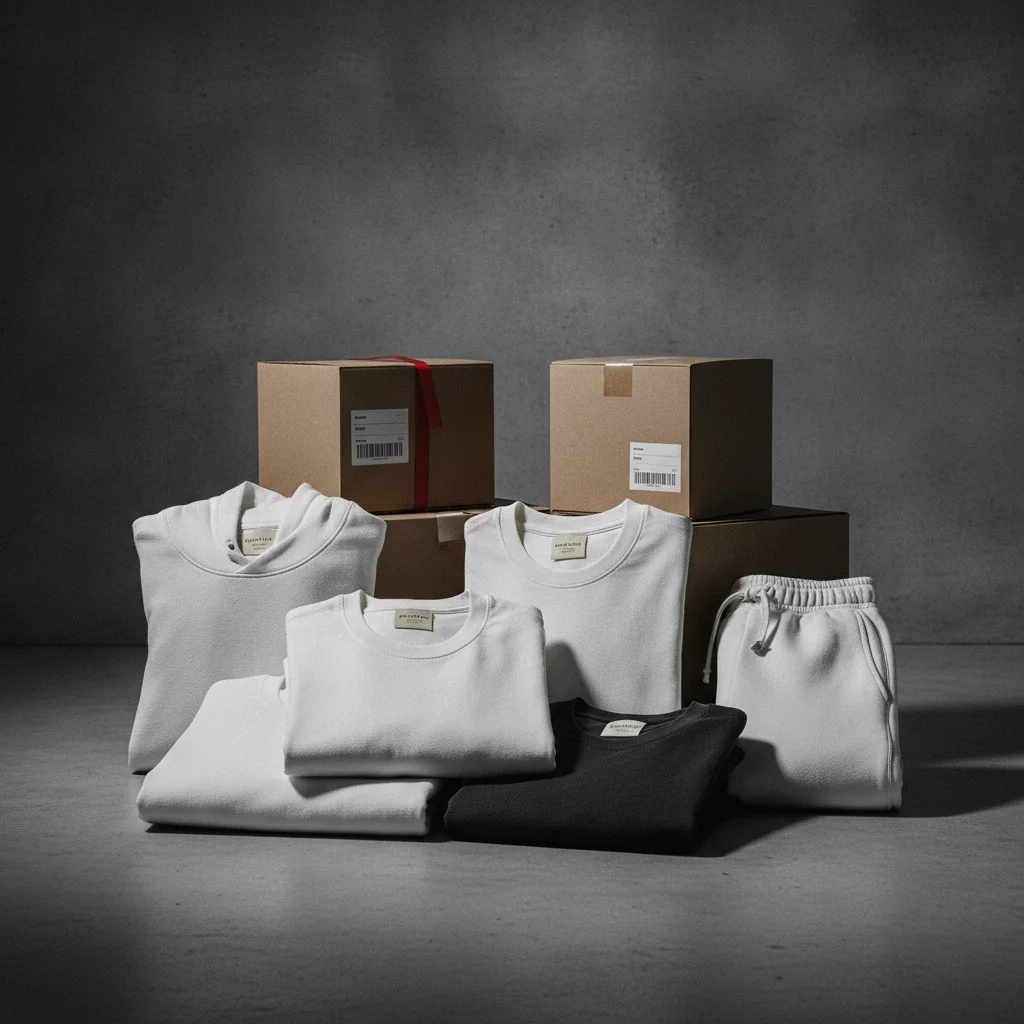
DDP shipping (Delivered Duty Paid) is a freight arrangement in which the manufacturer pays import duty, customs clearance fees, and international freight upfront, then bills the brand a single landed cost with drop-off at the door. It matters because it converts an unpredictable customs bill into a fixed, known cost quoted before production even starts – the brand knows the full cost of an order before committing to it, not after a shipment gets held at the border.
DDP is one of eleven standardized Incoterms (International Commercial Terms) published and maintained for international trade, defining who is responsible for what at each stage of a cross-border shipment. For a brand sourcing from an overseas factory, which Incoterm a manufacturer quotes under determines whether customs, duty, and last-mile drop-off are the factory’s problem or the brand’s.
DDP Defined in Full
Under DDP terms, the seller (manufacturer) is responsible for the goods and all associated costs – including export clearance, international freight, import duty, destination customs clearance, and drop-off to the buyer’s specified address – until the shipment physically arrives at the buyer’s door. The buyer (brand) has no customs or duty responsibility at any point. This is the maximum-responsibility Incoterm for a seller and the minimum-responsibility term for a buyer.
DDP vs Other Incoterms
EXW / FOB
Brand takes responsibility for freight booking, import duty, and customs clearance once goods leave the factory (EXW) or the origin port (FOB). Requires the brand to have or hire a customs broker.
DDP
Manufacturer handles freight, duty, and customs clearance from factory to the brand’s door. Brand pays one landed cost with no separate customs step.
DDU (Delivered Duty Unpaid) sits in between – freight is arranged by the seller, but the buyer still owes duty and customs fees at the border, which is where surprise bills most often come from.
What’s Included in a DDP Quote
| Cost Component | Included in DDP |
|---|---|
| Export customs clearance | Yes |
| International freight | Yes |
| Import duty | Yes |
| Import VAT / GST (where applicable) | Yes |
| Destination customs clearance | Yes |
| Last-mile drop-off to door | Yes |
Any manufacturer quoting “DDP” should be able to confirm each line above is included – a quote that excludes VAT or last-mile drop-off is not a full DDP quote regardless of the label used.
Why DDP Matters for Cash Flow and Planning
A brand budgeting a first production run needs to know the total landed cost per unit before committing – DDP delivers that number upfront, since duty and freight are already folded into the manufacturer’s quote. Under EXW or FOB terms, a brand cannot know its true per-unit cost until the shipment clears customs and a duty bill arrives, which makes margin planning and retail pricing decisions guesswork until the goods physically land. DDP removes that guesswork at the point of quoting, not after.
How DDP Works Step by Step
- Manufacturer completes bulk production and export-packs the finished order.
- Manufacturer’s freight partner handles export customs clearance and books international freight.
- Shipment arrives at the destination country and clears import customs, with duty and VAT paid by the manufacturer’s account.
- Shipment moves through last-mile transit to the brand’s specified address.
- Brand receives the order at its door – cleared, dropped off, with nothing further owed.
Red Flags: When “DDP” Isn’t True DDP
- The manufacturer asks the brand to provide an importer of record or tax ID for customs purposes – a genuine DDP shipment does not require this.
- A courier contacts the brand directly for a duty payment before drop-off – this signals DDU, not DDP.
- The quote does not specify whether VAT or GST is included alongside duty.
- No commercial invoice or tracking is provided ahead of the shipment’s arrival.
Any of these should prompt a brand to clarify shipping terms in writing before authorizing bulk production.
DDP by Market
DDP shipping to the USA covers duty and de minimis considerations under US customs rules. DDP to the UK covers post-Brexit import VAT and duty as one combined charge. DDP to EU countries (Germany, France, Netherlands, Italy, Spain, Sweden) covers EU import VAT and duty cleared at first port of entry. See import duties on custom clothing for how duty is calculated across these markets, and shipping from a Pakistan clothing factory for transit times by region.
Why DDP Became the Standard for First-Time Importers
A decade ago, EXW and FOB terms were the default in overseas apparel sourcing, leaving the buyer to arrange freight, insurance, and customs clearance through its own broker relationships – workable for established importers with in-house logistics teams, but a steep barrier for a first-time streetwear brand with no prior import experience. DDP shifted that burden to the manufacturer, which is why it has become the default expectation among newer brands sourcing custom apparel: it removes the need to build an import logistics function before a first order can even ship.
Calculating a True Landed Cost Per Unit
Landed cost per unit is the total DDP quote – garment cost, freight, duty, VAT, and clearance – divided by the number of units in the order. This is the number that should drive retail pricing decisions, not the garment cost alone, since garment cost by itself understates the real cost of getting product to market. A brand comparing two manufacturer quotes should always convert both to a landed cost per unit under equivalent DDP terms before deciding, since a lower headline garment price under EXW terms can end up costing more per unit once freight, duty, and a broker fee are added on the brand’s side.
| Quote Type | What the Brand Sees Upfront | What’s Missing |
|---|---|---|
| EXW | Garment cost only | Freight, duty, VAT, broker fee – all added later |
| FOB | Garment cost + origin freight to port | Destination freight, duty, VAT, broker fee |
| DDP | Full landed cost, door to door | Nothing – the quote is the total cost |
Documentation a Brand Should Keep From a DDP Shipment
Even though the manufacturer handles clearance under DDP terms, a brand should retain the commercial invoice, packing list, and any customs entry summary provided after a shipment clears – these documents support the brand’s own bookkeeping and give a reference point if a future shipment’s classification or duty rate needs to be compared against a prior one. Ask the manufacturer to forward this paperwork as a standard part of each DDP shipment rather than only on request.
How to Confirm a Manufacturer’s DDP Track Record
Before committing to a bulk order, ask a manufacturer for a rough outline of a past DDP shipment to the same destination market – the transit time achieved, whether any customs hold occurred, and how VAT or duty was itemized on the final invoice. A manufacturer with an established DDP process should answer these questions with specifics rather than a general assurance that shipping is handled. This is a reasonable question to ask alongside sample and production questions during the vetting stage, before a tech pack ever reaches the cutting table, and it costs nothing to ask upfront.
Negotiating DDP Terms Into a Quote
A first-time brand should ask for DDP terms explicitly when requesting a quote, rather than assuming a manufacturer’s default freight arrangement includes duty. Some factories quote EXW or FOB as a lower headline number, which looks attractive on paper until freight, duty, VAT, and a broker fee are added on top at the brand’s expense. Comparing quotes on a true landed-cost, DDP-to-DDP basis is the only apples-to-apples way to evaluate cost between manufacturers, and it is worth asking a manufacturer to itemize duty and freight separately within the DDP total so a brand can see exactly how the landed cost breaks down, not only the final total figure.
DDP and Reorders
Once a first order has shipped DDP successfully, reorders on the same design typically move through the same customs classification and clearance process with no new setup required – the HTS classification and landed-cost structure carry over, which is part of why locking a manufacturer with a working DDP process on order one pays off across each subsequent reorder.
How Minku Apparel Implements DDP
Minku Apparel ships each order worldwide on true DDP terms from its Pakistan factory – export clearance, international freight, import duty, import VAT where applicable, destination clearance, and last-mile drop-off are all built into one landed cost quoted before production begins. Brands in the USA, UK, and across Europe receive finished orders at their door, cleared, with no broker to hire and no duty bill to settle separately, and each landed-cost quote itemizes freight and duty so the brand sees exactly what is being paid for before production begins.
For the wider manufacturing picture, see our custom streetwear manufacturer pillar page, and for US-specific manufacturing detail, streetwear manufacturer in USA.
What Is DDP Shipping and Why It Matters — In Detail