Embroidery stitches thread through fabric to build a raised, textured logo, while screen printing pushes ink through a mesh stencil onto the fabric surface. Embroidery wins on durability and a premium hand-feel for logos and small marks; screen printing wins on cost efficiency for large graphics and full-color designs. Neither method beats the other outright – the design and the placement decide which one earns its cost.
This page compares both across durability, cost, design limits, and where each fits a streetwear line, with real numbers on MOQ and turnaround. If you know your design already, get your custom quote and we will confirm the method.
What Embroidery Is
Embroidery uses a computerized machine to stitch a digitized design into fabric with polyester or rayon thread, building up texture and dimension rather than laying flat color on the surface. Puff embroidery adds a foam layer underneath the stitching for a raised, 3D effect popular on streetwear logos and text marks. See our custom embroidery manufacturing page for the full process.
Because it is physically stitched into the fabric rather than printed on it, embroidery cannot fade, crack, or peel the way a surface print can – its failure mode is thread fraying at the edges after years of heavy wear, not color loss.
What Screen Printing Is
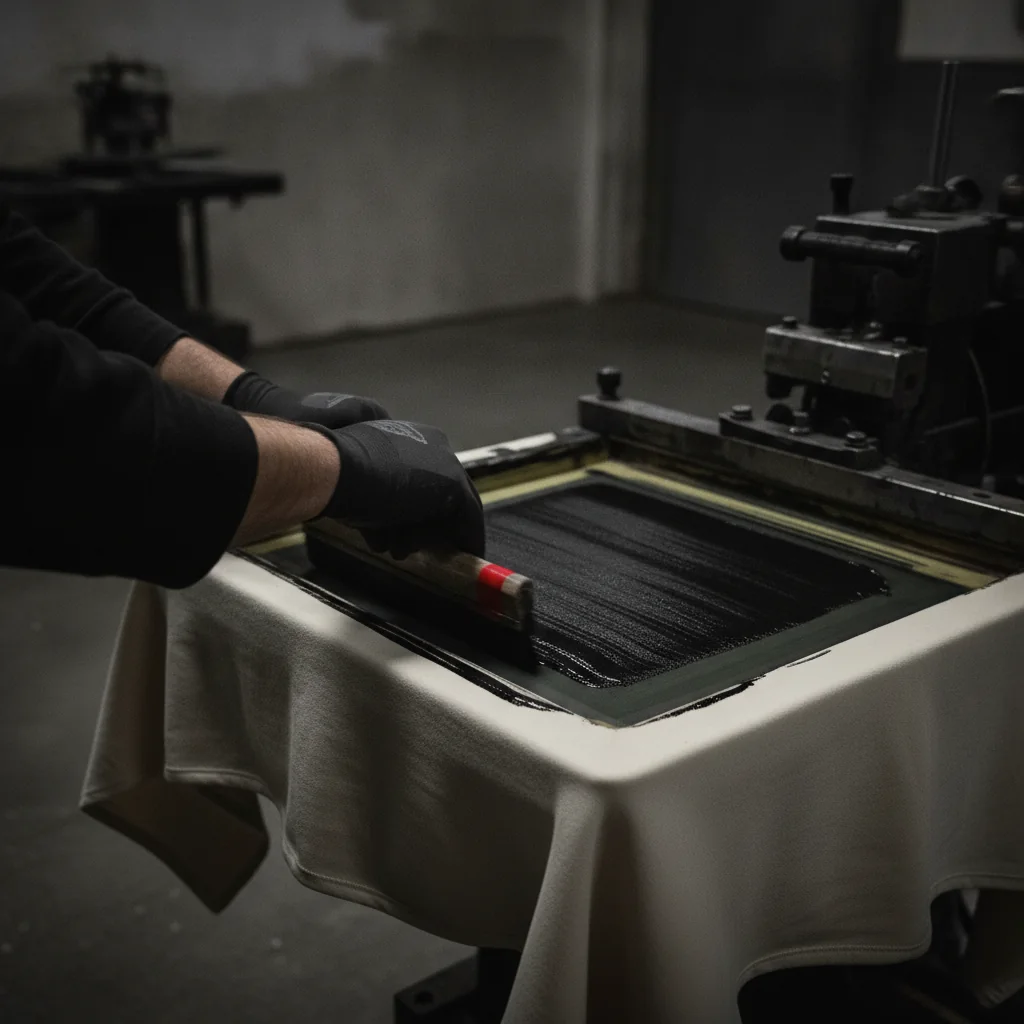
Screen printing pushes ink through a fine mesh screen with a stencil cut for each color in the design, building up a print one color layer at a time. It is the standard method for large graphics, full-back prints, and designs with flat, bold color blocks rather than fine detail. See our screen printing manufacturing page for setup and process detail.
Each additional color in a screen print design needs its own screen and its own pass through the press, which is why screen print pricing scales with color count in a way embroidery pricing does not.
Embroidery
Stitched texture, raised feel. Best for logos, text, and small marks. Will not fade, crack, or peel. Higher cost per color-dense design.
Screen Printing
Flat ink on fabric surface. Best for large graphics and bold color blocks. Cost scales with color count. Efficient for bigger print areas.
Durability Compared
Embroidery is the more durable of the two for its intended use – a stitched logo holds its shape and color for the life of a garment because thread does not fade or crack under normal washing. Its limit is size and detail: dense, photographic designs are impossible to embroider cleanly and would take an impractical stitch count even if attempted.
Screen print durability depends heavily on ink type and curing. A correctly cured plastisol or water-based print on cotton holds through years of normal washing, but repeated high-heat drying or harsh washing accelerates surface cracking over time in a way embroidery does not experience.
| Factor | Embroidery | Screen Printing |
|---|---|---|
| Best for | Logos, text, small marks | Large graphics, full-color art |
| Durability | Will not fade or crack | Strong with correct curing |
| Cost driver | Stitch count, thread colors | Number of print colors |
| Detail limit | Fine detail is difficult | Photographic detail possible |
| Hand-feel | Raised, textured | Flat, can feel thick if heavy ink |
| MOQ | From 50 pcs | From 50 pcs |
Cost and MOQ Breakdown
Embroidery cost is driven by stitch count and thread color changes – a small, simple logo runs efficiently, while a large, dense design with many colors adds meaningful digitizing and run time. Screen print cost is driven by the number of colors, since each color needs its own screen; a single-color back print is one of the more efficient decorations available, while a six-color photographic design approaches DTG territory in cost.
Both methods share a 50-piece MOQ per design at Minku, so entry cost is not the deciding factor – the design itself, and where it sits on the garment, is what determines which method earns its cost.
Where Each Shows Up on a Garment
Embroidery is the standard for chest logos, sleeve marks, hood details, and small text – anywhere a brand wants a mark that reads as premium and holds its shape for the life of the piece. It rarely covers large areas because stitch count and production time climb fast past a few square inches of dense coverage.
Screen printing covers the rest: full front and back graphics, oversized text, and photographic or gradient designs that need flat color across a larger area. Streetwear brands commonly combine both on one garment – an embroidered chest logo paired with a screen-printed back graphic – which we run as a single production order.
Which One Reads as More Premium
Embroidery generally reads as the more premium mark because of its texture and permanence – a puff-embroidered logo has a tactile, dimensional quality a flat print cannot replicate, which is why it shows up so often on premium streetwear as the signature brand mark even when the rest of the garment carries a screen-printed graphic.
That said, a well-executed large-scale screen print with careful registration and a soft-hand ink base reads as premium too. The perception gap is less about the method itself and more about execution quality – a poorly cured, thick screen print looks and feels lower-tier regardless of the method chosen.
Where Each Method Came From
Embroidery is one of the oldest forms of textile decoration, predating industrial manufacturing by centuries as a hand craft before computerized machines took over stitch placement in the twentieth century, making consistent, repeatable logos possible at production scale. Puff embroidery, the raised 3D style common on streetwear, developed later as a foam-backing technique specifically for branded apparel.
Screen printing traces to stencil printing techniques refined for textile use in the twentieth century, becoming the dominant apparel decoration method once mesh screens and photo-emulsion stencils made multi-color registration reliable and repeatable at volume. It remains the default for large-format graphic tees because no other method covers a comparable area at a comparable cost.
Care and Longevity
Embroidered garments hold up to standard washing with almost no special care, though loose thread ends should be trimmed rather than pulled if they appear after heavy wear, since pulling can unravel a stitch line. Screen-printed garments benefit from washing inside out on a standard cycle and avoiding high-heat drying, which is the leading cause of premature surface cracking on any topical print.
Choosing Fabric to Match the Method
Both embroidery and screen print run on the same core fabrics we manufacture in – heavyweight cotton, French terry, fleece – so fabric choice does not usually force a decision between the two methods the way it does with sublimation. The exception is thin or stretch-heavy fabric, where dense embroidery can pucker the material if backing and stabilizer are not matched correctly to the fabric weight.
A Real Example
A UK streetwear brand wanted a hoodie with a small embroidered logo on the chest and a large graphic across the back. We digitized the chest logo at roughly 4,000 stitches in a single thread color, ran it with puff embroidery for a raised finish, then screen printed the back graphic in four colors on the same 400 GSM fleece hoodie. Combining both methods in one production run kept the order on a single timeline rather than splitting it across two suppliers, and the finished garment carries the durability of embroidery on the logo with the coverage of screen print on the back.
Common Mistakes Brands Make
The most frequent mistake is requesting embroidery for a large, photographic or gradient-heavy design, which either cannot be digitized cleanly or requires an impractical stitch count and cost. The second is using screen print for a small, permanent brand mark meant to represent the label for years, when embroidery’s durability and texture would serve that role better.
A simple guide: if the design is small, simple, and meant to last as the brand’s signature mark, lean embroidery. If the design is large, detailed, or color-dense, lean screen print. If your design mixes both needs, split it across the two methods on the same garment rather than forcing one method to do both jobs. Sending a flat vector file of your artwork upfront, rather than a low-resolution photo, also avoids a round of back-and-forth on both methods, since digitizing and screen separation both start from clean line work.
How Minku Runs Both Decoration Methods
Our Pakistan factory runs embroidery and screen printing in-house alongside DTG, puff print, and all-over print, so a combined order like a logo-plus-graphic hoodie ships from one production run with one QC standard applied across both decoration methods. We will tell you which method fits your artwork honestly rather than pushing whichever is more efficient for us to run.
Send your artwork and we will confirm stitch count or color count, MOQ, and timeline, then get your custom quote to lock the order. For the full build and decoration range across our product line, see the custom clothing manufacturing hub.
Embroidery vs Screen Printing: Pros and Cons — In Detail