The MOQ (minimum order quantity) for custom sweatshirts starts from 50 pieces per design, making it possible for a new brand to launch a first drop without committing to a warehouse-sized order. That 50-piece floor applies per design and colorway – a brand launching three designs in two colors each would need to meet the minimum on each combination, not the total unit count across the whole drop. This page explains how MOQ works, why manufacturers set a floor at all, how it interacts with colorways and reorders, and how to plan an order size that matches both budget and real demand.
Why Manufacturers Set a Minimum Order Quantity
Custom manufacturing carries fixed costs regardless of order size – fabric has to be cut from a bulk roll, screens have to be burned or thread digitized for embroidery, and a production line has to be set up and torn down. Below a certain unit count, these fixed costs make per-unit pricing impractical for both the brand and the manufacturer. A 50-piece MOQ balances that reality against the needs of a new brand testing a first design, without pushing the floor up to 500 or 1,000 units the way some larger manufacturers do.
How MOQ Applies Across Designs and Colorways
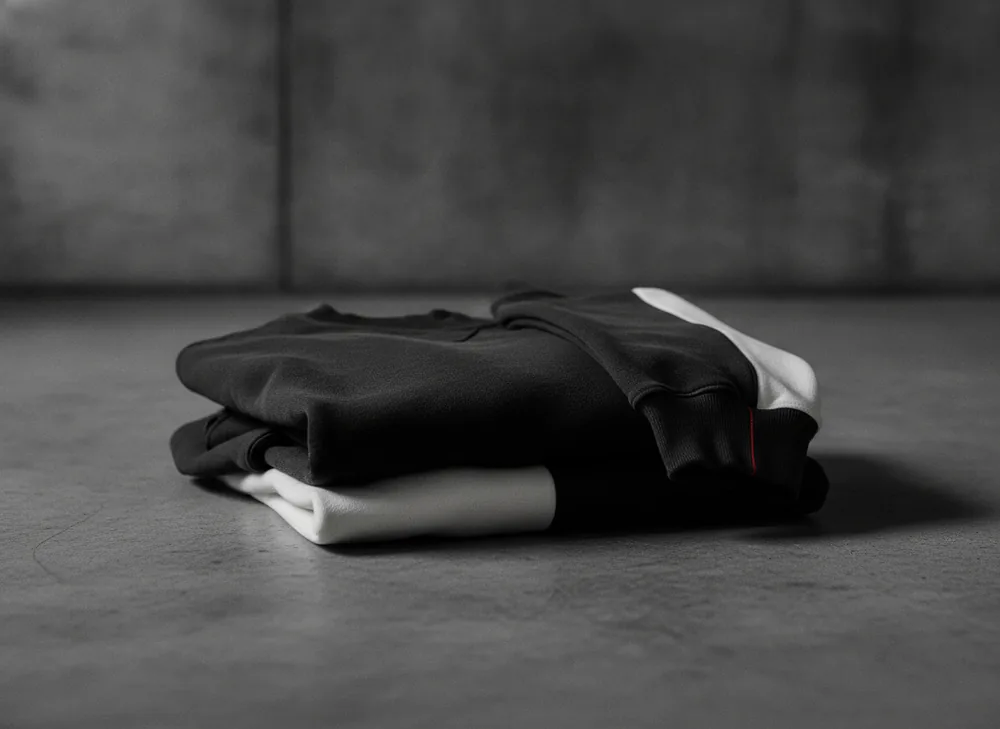
MOQ is typically counted per unique design and colorway combination, not across an entire order. A brand ordering one crewneck design in black and one in cream needs 50 units of each color to meet MOQ on both – 100 units total, not one shared 50-unit minimum across the two colors. Some manufacturers allow mixing sizes freely within a single colorway to hit the minimum (an XS through 2XL breakdown all counting toward the same 50-piece floor), which is standard practice and worth confirming at quote stage.
| Order Scenario | MOQ Requirement |
|---|---|
| One design, one colorway | 50 pieces total across the size range |
| One design, two colorways | 50 pieces per colorway (100 total) |
| Two designs, one colorway each | 50 pieces per design (100 total) |
| Reorder of an approved design | Same 50-piece floor per colorway applies |
Does MOQ Change With Fabric or Decoration?
The 50-piece floor generally holds across the standard 240-400+ GSM cotton, French terry, and fleece range and across all in-house decoration methods – screen print, DTG, puff and flat embroidery, acid wash, garment dye, tie-dye, and all-over print. Highly custom requests, such as a fabric blend not normally stocked or a wash treatment requiring extensive testing, can sometimes carry a higher practical minimum simply because sourcing or testing a small custom batch is not efficient below a larger volume – this gets confirmed at the quote stage rather than assumed.
MOQ vs Order Size: What Actually Makes Sense
Ordering at the exact 50-piece MOQ floor is common for a first design test, but per-unit cost drops meaningfully as order size increases past that floor, since fixed costs (screen setup, sample amortization, freight-per-unit) spread across more units. A brand confident in a design from early customer interest or pre-orders often orders 150-300 units on a first run rather than the bare minimum, landing at a noticeably lower per-unit cost while still keeping inventory risk manageable.
A Practical Example
A brand testing two sweatshirt designs might order 50 units of each at MOQ for a first test drop – 100 units total – to validate demand with limited upfront investment. If both designs sell through quickly, the brand reorders at 200-300 units per design on the next run, both to meet growing demand and to capture the lower per-unit pricing available at higher volume.
Why Low MOQ Matters for New Brands
A high MOQ (500 or 1,000+ pieces per design, standard at many overseas factories) forces a new brand to commit significant capital and warehouse space before a design has sold a single unit. A 50-piece MOQ lets a founder test multiple designs, colorways, or even fabric weights across several small orders before scaling the proven winners into larger reorders – reducing the financial risk of a first collection considerably compared to committing the whole budget to one large, unproven run.
MOQ and Private Label Details
Full private label finishing – woven neck labels, custom hangtags, branded packaging – is available at the standard 50-piece MOQ, not gated behind a higher minimum. This matters because private label details are often what separates a factory-direct sweatshirt from a generic blank once it reaches a customer; a new brand should not have to choose between a low MOQ and full branding on their first run.
How MOQ Compares Across Manufacturers
Low-MOQ Manufacturer (Minku Apparel)
50 pieces per design and colorway. Full private label and full decoration range available at that floor. Sampling included before bulk. Suited to new brands testing a first drop or an established brand launching a limited colorway.
High-MOQ Manufacturer
Often 500-1,000+ pieces per design. Lower per-unit cost at volume, but requires significant upfront capital and warehouse space before a design has proven demand. Better suited to an established brand reordering a proven bestseller at scale.
Planning Your First Order Around MOQ
Brands new to manufacturing should plan a first order at or slightly above MOQ (50-150 units per design) to keep capital exposure manageable while still getting the benefit of a small volume price reduction over the bare minimum. Reserving budget for a second production run once the first sells through – rather than over-ordering on an unproven design – is the more capital-efficient path for most new streetwear brands. A brand should also factor in how quickly a design is likely to sell through: a core, always-in-catalog crewneck style can support a larger order size safely, while an experimental limited-run design is better tested closer to the 50-piece floor until demand is proven.
How Reorders Interact With MOQ
Once a design and colorway has been produced at least once, a reorder still needs to meet the same 50-piece floor per colorway, but skips the sampling stage entirely since fit, fabric, and decoration are already confirmed. This makes small reorders more efficient than a first order at the same unit count – a 50-piece reorder moves straight to bulk cutting, while a 50-piece first order includes a 7 to 12 day sampling stage before bulk production starts.
Ordering Multiple Product Lines Together
A brand launching a sweatshirt alongside a matching hoodie, t-shirt, or tracksuit in the same drop needs to meet the 50-piece MOQ on each product and colorway independently – a sweatshirt and a hoodie are different patterns and construction, so neither counts toward the minimum for the other. Combining several products into one shipment is efficient for freight consolidation under DDP shipping even though each product line has its own separate MOQ requirement.
Common MOQ Misunderstandings
- Assuming MOQ is a suggestion, not a firm floor – fixed costs like screen setup or embroidery digitizing make a below-MOQ order impractical to price fairly for either side.
- Assuming one MOQ covers an entire multi-design drop – each design and colorway combination carries its own 50-piece requirement.
- Assuming higher MOQ always means lower quality – MOQ reflects the production model a manufacturer uses, not the fabric or construction standard applied to the garment.
- Assuming samples count toward MOQ – a pre-production sample is a separate, smaller step and does not count against the 50-piece bulk minimum.
- Assuming MOQ never changes for reorders – the 50-piece floor still applies on a reorder of an approved design and colorway, though sampling is skipped, making reorders faster to fulfill at the same minimum.
MOQ Considerations for US, UK, and EU Brands
Brands in the US, UK, and across Europe all face the same 50-piece MOQ floor per design and colorway, since the minimum is set by production economics at the factory rather than by destination market. What changes by market is how the shipment is handled on arrival: DDP shipping bundles duties and customs clearance into the quoted landed cost regardless of order size, so a 50-piece test order and a 500-piece reorder both arrive with the same fixed-cost, no-surprise customs process. A brand splitting a small order across two markets – say 30 units held back for a UK pop-up and 20 shipped to a US warehouse – should confirm with the manufacturer whether that split still needs to clear the 50-piece MOQ as a single combined production run before splitting for shipping, which is standard practice.
How Minku Apparel Structures MOQ
Minku Apparel manufactures custom sweatshirts from 50 pieces per design and colorway, across the full 240-400+ GSM cotton, French terry, and fleece range, with in-house screen print, DTG, embroidery, and wash treatments all available at that floor. Each order includes a pre-production sample before bulk cutting and full private label finishing, with DDP shipping to the US, UK, and EU included in the quote.
For the full manufacturing process behind this MOQ, see the custom sweatshirt manufacturer page. To see how order size affects unit pricing, read how much custom sweatshirts cost to manufacture, and for the full production timeline at this order size, see how long custom sweatshirts take to manufacture. Ready to test a first design at MOQ? Get a custom quote today.
What Is the MOQ for Custom Sweatshirts? — In Detail