Private label clothing is apparel manufactured by a factory but branded, labeled, and sold entirely under the ordering brand’s own name – the factory’s involvement stays invisible to the end customer, who only ever sees the brand’s neck label, woven tag, hangtag, and packaging. This is the standard model for independent streetwear labels: a founder’s brand name is the only name that appears anywhere on the finished product.
Private label differs from buying a factory’s existing product and slapping a sticker on it – a full private-label order replaces every point where a factory’s own identity might otherwise appear, down to the neck label sewn into the garment itself.
What “private label” covers in a manufacturing order
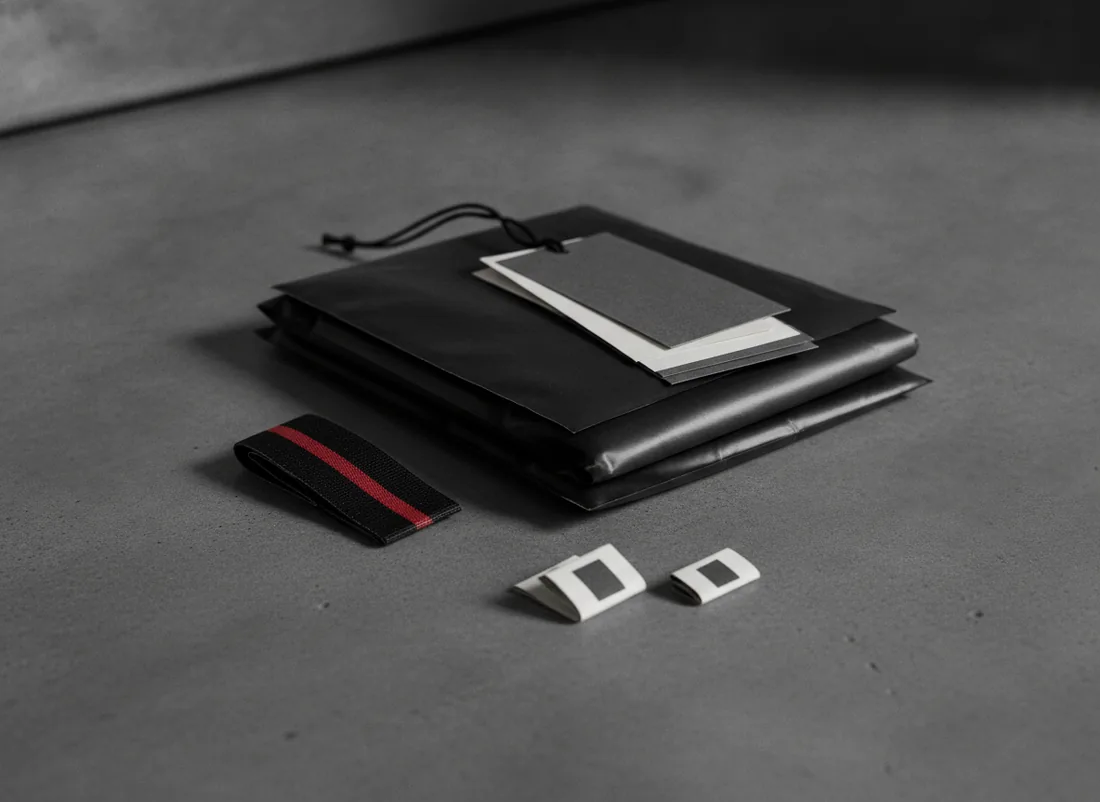
A complete private-label order replaces four touchpoints with the brand’s own identity: the neck label (sewn inside the collar), woven or printed care/size tags, exterior hangtags attached at the point of sale, and packaging – polybags, boxes, or mailers – that the customer sees when a garment arrives. Any one of these left as factory-default breaks the private-label promise, since a customer who spots an unfamiliar factory tag loses confidence in the brand they thought they bought from.
Private label also typically covers custom size and care labeling in the brand’s own format, and can extend to custom-printed poly bags or branded tissue paper for a more complete unboxing experience on direct-to-consumer orders.
Private label vs white label – the key difference
Private label
Manufactured to the brand’s own design and specification, branded entirely under that brand’s name.
White label
A factory’s existing, often shared product design, which multiple brands can order and simply label as their own.
White label is faster to launch since the design work is already done, but the underlying garment may be available to competing brands from the same factory. Private label, built from a brand’s own tech pack, gives a brand a design that is not shared across other labels sourcing from the same manufacturer. See our full comparison on private label vs white label.
How private label relates to OEM manufacturing
Private label describes the branding outcome; OEM describes the manufacturing relationship that usually produces it. A brand working with an OEM manufacturer supplies its own design and specification, and that manufacturer applies full private-label branding to the finished product – the two concepts work together in most independent streetwear supply chains rather than describing separate processes.
Custom labels, tags, and packaging in detail
Neck labels
Neck labels are typically woven or printed, sewn into the inside back collar seam during construction. Woven labels read as a more premium, durable finish and hold up to repeated washing better than a printed label directly on fabric.
Woven size and care tags
Size and care information is required by most markets’ labeling regulations and is typically produced as a separate small woven or printed tag, positioned at the side seam, carrying the brand’s own format alongside required fiber-content and care-instruction text.
Hangtags and packaging
Hangtags attach externally via a plastic tag pin or string and carry brand story, sizing, or pricing information at the point of sale. Packaging – polybags, branded boxes, or mailers – forms the first physical impression for direct-to-consumer orders and is fully customizable under a private-label order. See custom labels, tags and packaging for the full breakdown of options.
Why private label matters for brand value
A garment that carries only the brand’s own labeling, with no visible trace of the manufacturing factory, reads as a complete, legitimate product line rather than a reseller arrangement. This matters for wholesale buyers evaluating a brand for stockist placement, and for direct customers who expect a cohesive, professional unboxing experience consistent with the brand’s marketing.
Private label is also what allows a brand to build resale and reorder value in its own name – since the design, construction, and branding are all specific to that brand, customers associate quality and fit consistency with the brand itself rather than an anonymous supply chain.
Private label for multi-product lines
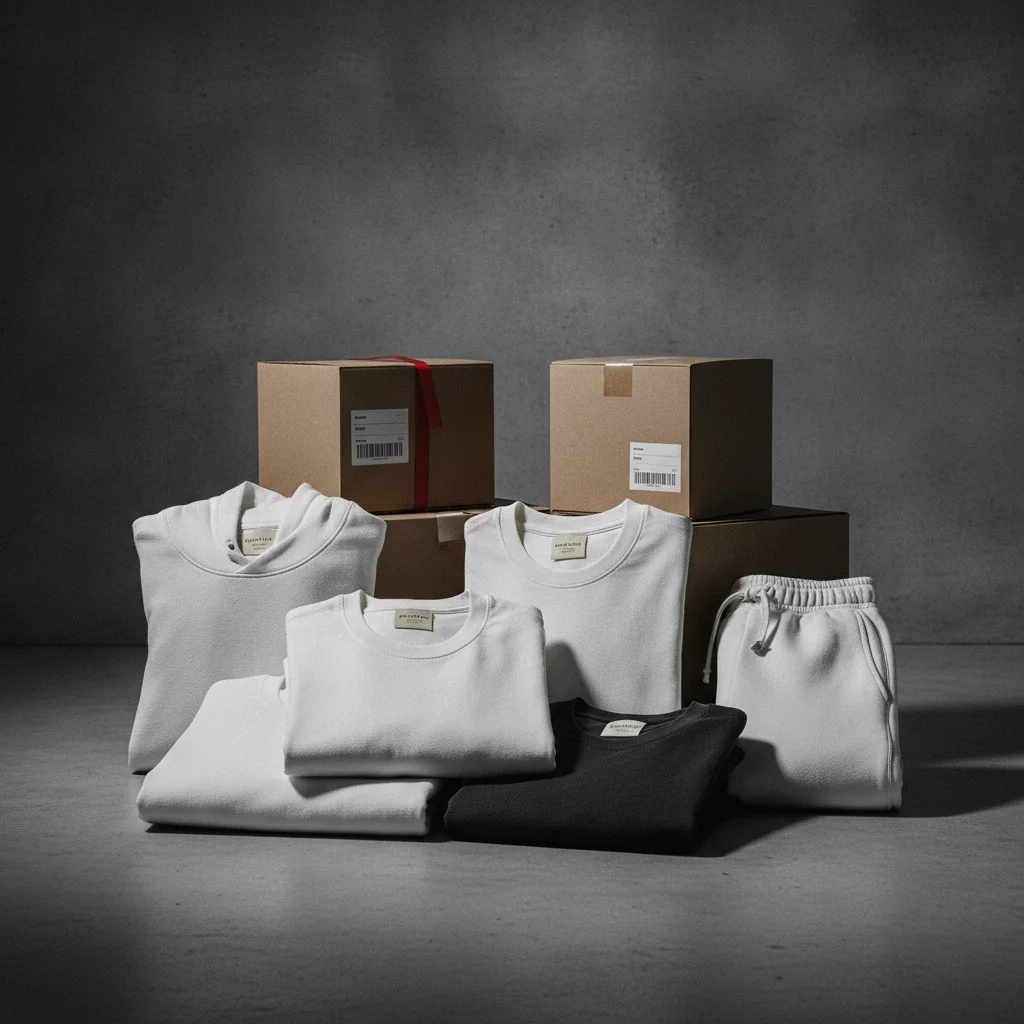
A brand launching across several product categories at once – hoodies, tees, and shorts in the same drop, for example – benefits from a single consistent label specification applied across every garment type rather than a separate label design per product. This keeps brand presentation unified and simplifies label production, since one artwork file and one woven-label order can cover multiple garment styles rather than requiring separate setups for each.
Where garment types differ enough in construction (a shorts waistband tag placement versus a hoodie neck label, for instance), the label content and branding stay consistent even where physical placement has to adapt to the garment’s construction.
MOQ and cost considerations for private label
Custom labels and tags typically carry their own minimum order quantities separate from the garment MOQ, since woven labels are produced on a dedicated loom run and printed tags on a dedicated print run. A factory experienced in private-label production for new brands, like Minku, coordinates label MOQ with garment MOQ so a first order of 50 pieces per design does not get held up waiting on a much larger label minimum.
Packaging customization (printed polybags, branded boxes) generally scales more flexibly than woven labels, so brands on a first order sometimes start with a simpler packaging option and add custom printed packaging once volume increases.
Sampling private-label details before bulk
Label placement, size, and attachment method should be confirmed on the pre-production sample alongside fit and fabric approval – a neck label sewn slightly too low or a hangtag attached through a visible seam are exactly the kind of details a sample catches before they repeat across an entire bulk order.
Brands should also confirm label artwork files (vector format, correct dimensions) are finalized before bulk cutting starts, since label production usually runs on its own separate timeline from garment cutting and needs to be ready in parallel, not after garments are already sewn.
Common private-label mistakes new brands make
A frequent mistake is finalizing garment production before locking label artwork, which pushes label production onto a rushed, compressed timeline that risks quality shortcuts on the one detail a customer inspects up close. Another is under-specifying label material – choosing a printed label where a woven one was expected, or the reverse – which surfaces as a mismatch between the brand’s intended premium positioning and the label’s actual feel in hand.
A third common mistake is not confirming country-of-origin or fiber-content labeling requirements for the specific markets an order ships to, since the US, UK, and EU each have distinct mandatory label-content rules that a factory experienced in exporting to those markets should already account for as part of a standard private-label setup.
Private label and quality perception
Customers judge a garment’s overall quality partly through its labeling details – a crisp, well-attached neck label and a solidly printed hangtag signal the same care as the stitching and fabric itself, while a crooked label or a flimsy hangtag can undercut an otherwise well-made garment. Private-label finishing is not a cosmetic afterthought; it is part of how a customer reads the overall product quality on first contact.
This is especially relevant for a new brand’s first drop, where customers have no prior track record with the label to draw on – the physical product, labeling included, is doing all the work of establishing trust and perceived value in that first impression.
Private label across reorders
Consistency in private-label details matters across reorders the same way fabric and fit consistency does – a neck label that shifts position, a hangtag printed on different stock, or packaging that changes without explanation all read as inconsistency to a repeat customer, even if the garment itself is identical. A manufacturer that retains label specifications and artwork files from the original order protects this consistency automatically on future reorders.
Brands scaling past a first drop should ask their manufacturer how label and packaging specifications are stored and referenced for reorders, rather than assuming details will be remembered correctly without documentation.
Private label and starting a new brand from scratch
For a founder launching a first apparel line with no prior manufacturing relationship, private label is what makes an OEM factory relationship viable at a founder-friendly scale – a brand does not need its own labeling infrastructure, printing equipment, or packaging supplier, since a manufacturer experienced in private label handles all of it as part of the production order itself.
This is a meaningful part of what has lowered the barrier to launching an independent streetwear brand over the past decade: a founder with a design and a name can produce a fully branded, retail-ready product without building out any of the physical branding supply chain themselves.
How Minku delivers full private label
Every order at Minku includes full private-label branding as standard – your own neck labels, woven tags, hangtags, and packaging, with zero factory branding anywhere on the finished product. We coordinate label production timelines with cutting and sewing so private-label finishing does not become the bottleneck on your launch date.
Explore our custom labels, tags and packaging page for label specification detail, or the private label clothing manufacturer hub for our full private-label production capability. Ready to brand your first drop? Get Your Custom Quote.
What Is Private Label Clothing? — In Detail