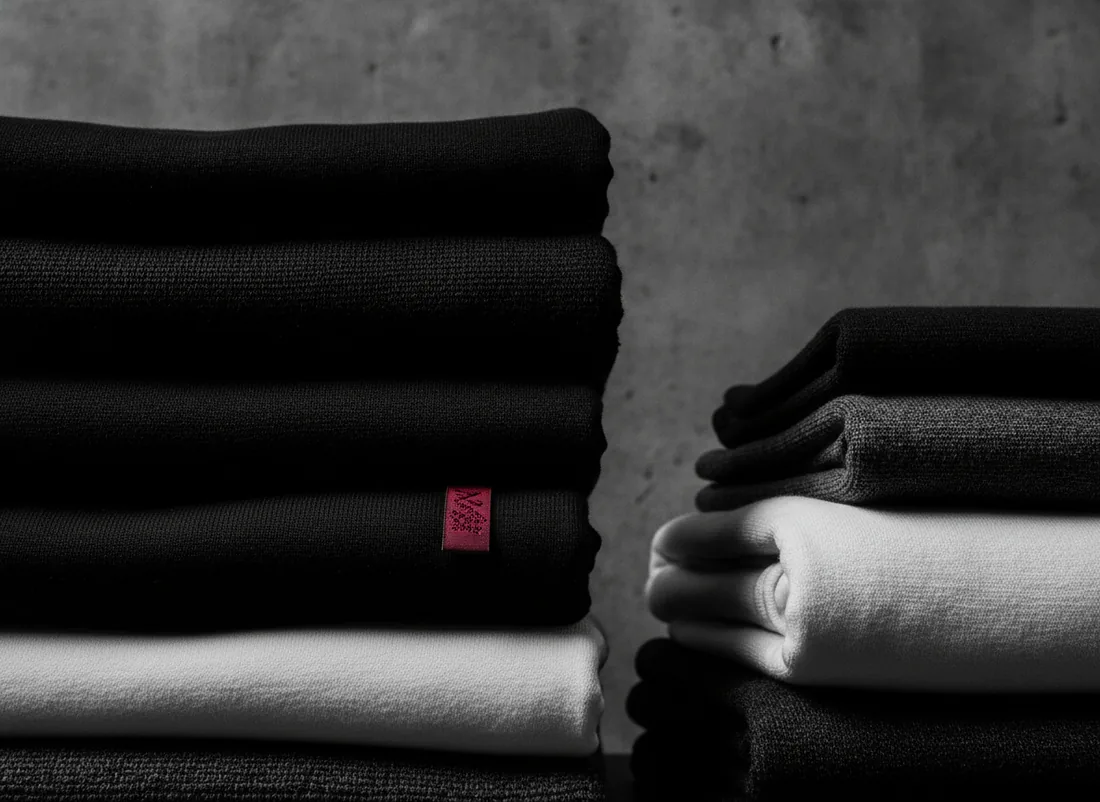
CMT manufacturing stands for Cut, Make, Trim – a production model where the brand supplies the fabric and trims and the factory only cuts, sews and finishes the garment. It is the leanest manufacturing arrangement in terms of what the factory provides, and it puts fabric sourcing, quality and cost entirely in the brand’s hands.
Under CMT, the factory is paid for labor and construction only, not for materials. That single distinction shapes the rest of how the arrangement works: who carries sourcing risk, how minimum order quantities behave, and which brands the model actually suits.
What CMT actually covers
Cut, Make, Trim describes the three services the factory performs: cutting fabric to the pattern, making (sewing and constructing) the garment, and applying trims – labels, drawstrings, zippers, buttons – that the brand has already sourced and shipped to the factory. Decoration such as screen print or embroidery may or may not be included depending on the arrangement; some CMT deals cover construction only, with decoration handled as a separate step.
What CMT does not include is sourcing. The factory does not select, buy or hold stock of fabric on the brand’s behalf. If the fabric arrives late, in the wrong quantity, or with a flaw, that is the brand’s problem to resolve, not the factory’s, since the factory only committed to construction quality on the materials it was given.
Who supplies what under CMT
The brand is responsible for sourcing and shipping fabric in the correct width, weight and quantity to cover the pattern layout plus a cutting allowance, along with any trims, drawstrings, zippers and labels specified in the tech pack. This typically means the brand has an existing relationship with a fabric mill or supplier, separate from the garment factory.
The factory is responsible for pattern cutting, sewing to spec, and finishing to the agreed quality standard, using only the materials supplied. This division of labor is why CMT pricing is quoted as a labor-only cost per unit, distinct from the material cost the brand pays separately to its own suppliers.
When CMT makes sense
CMT suits brands that already have an established fabric supply chain – a proprietary or exclusive material, a mill relationship built over multiple seasons, or purchasing volume that secures better fabric pricing than a factory would pass through when sourcing on the brand’s behalf. In these cases, paying only for construction can improve margin meaningfully.
It also suits brands with the operational capacity to manage logistics: inspecting incoming fabric for defects, holding buffer stock, coordinating shipping fabric to the factory ahead of a production slot, and absorbing the risk if a fabric shipment is delayed or flawed. Without that capacity in place, CMT introduces more operational risk than the cost saving it is meant to deliver, which is why most brands only move to this model once their supply chain is mature enough to support it.
CMT vs full package production
CMT
Brand sources fabric and trims. Factory cuts, sews and finishes only. Labor-only pricing. Full material control, full material risk on the brand.
Full package production
Factory sources fabric, trims and all remaining materials, delivering a finished garment. One accountable partner, faster path for brands without a supply chain already in place.
For most new and scaling brands, full package production removes a barrier CMT reintroduces: sourcing heavyweight fabric at a workable minimum. See our full comparison at CMT vs full package production.
Cost structure of CMT
Because the factory is paid for construction labor alone, CMT pricing is quoted per unit for cutting, sewing, trimming and finishing, separate from whatever the brand pays its fabric supplier. This can make CMT appear to have a lower unit cost on paper, but the true cost comparison has to include the brand’s own fabric-sourcing cost, freight to the factory, and any inventory risk on unused fabric.
A fair comparison against full package production, where fabric cost is bundled into a single per-unit price, means adding the brand’s material and logistics costs to the CMT labor rate before judging which route is more cost-effective for a given order size.
Fabric sourcing risk under CMT
The brand carries all sourcing risk in a CMT arrangement. If a fabric roll comes in under-width, off-color from a previous lot, or below the specified GSM, the factory is not responsible for that fault since it only worked with what was supplied – the brand has to resolve the issue with its fabric supplier separately, which can delay production while a replacement or credit is sorted out.
This risk is manageable for brands with an inspection process and a reliable supplier relationship, but it is a genuine operational burden that full package production removes by keeping fabric sourcing, and the accountability for it, inside the manufacturer.
Minimum order quantities in CMT
The sewing MOQ in a CMT arrangement can be lower than a full package MOQ, since the factory is only committing labor capacity rather than a mill’s fabric minimum. However, the brand’s own fabric supplier likely has its own minimum order for the roll or bolt of fabric needed, and that fabric minimum can end up higher than what the sewing line requires.
This means the real effective minimum for a CMT order is often set by the fabric supplier, not the garment factory – a detail brands sometimes miss when comparing CMT’s advertised sewing MOQ against a full package manufacturer’s all-in minimum of 50 pieces per design.
Sampling in a CMT arrangement
Sampling under CMT depends on the brand’s fabric arriving at the factory first, since the sample is cut from the same material the bulk order will use. This means sample timing is tied to the brand’s own supply chain rather than the factory’s stock, and any delay in shipping fabric to the factory pushes the whole sampling timeline back.
Once fabric is on hand, the factory builds a pre-production sample the same way it would for any order – checking fit, construction and trim placement against the tech pack before bulk cutting is scheduled.
Quality control responsibilities under CMT
Quality control in a CMT arrangement splits along the same line as the rest of the arrangement: the factory is accountable for construction quality – stitch consistency, seam strength, measurement accuracy against the pattern – while the brand is accountable for the quality of the fabric and trims it shipped. A finished garment can fail inspection for reasons on either side, and sorting out which side caused a fault matters for resolving it.
Because of this split, a factory running CMT typically documents incoming fabric condition on arrival – noting any visible flaws, off-width rolls or shade variation – before cutting begins, so there is a clear record of what was supplied versus what the factory’s own construction process introduced. Brands should expect and request this kind of intake documentation from any CMT manufacturer.
Freight and logistics in a CMT arrangement
CMT adds a logistics leg that full package production does not require: shipping fabric and trims from the brand’s supplier to the factory before production can start. For a Pakistan-based factory serving brands in the USA, UK or Europe, this typically means the brand’s fabric supplier ships to the factory first, adding transit time and a freight cost the brand carries directly, separate from the DDP shipping of the finished goods back to the brand’s market.
This extra freight leg is worth factoring into any CMT timeline planning, since a delay in fabric arriving at the factory pushes back cutting, sampling and the entire production schedule in a way that does not happen under full package, where the factory already holds or sources its own fabric on-site.
CMT and private labeling
Private labeling still applies under CMT, but the responsibility for the labels themselves usually shifts to the brand. Neck labels, woven tags and hangtags are trims, so in a CMT arrangement the brand typically designs, orders and ships these to the factory alongside the fabric, rather than the factory sourcing generic labels and adding brand artwork in-house as it would under full package.
This gives a brand full control over label material, print method and placement instructions, but it also adds one more supplier relationship and one more shipment to coordinate before production can start. Brands weighing CMT should factor label sourcing and lead time into the same planning as fabric sourcing, since both need to arrive at the factory before cutting begins.
How Minku handles CMT orders
We run full package production as our standard model, sourcing 240-400+ GSM cotton, French terry and fleece so brands do not have to manage a separate fabric supply chain. For established brands that already source their own fabric, we also support CMT arrangements, cutting, sewing and finishing to your tech pack from the materials you supply.
Tell us your product, fabric source, label plan and quantity, and we will quote the labor-only CMT rate or the full package alternative, whichever fits how your supply chain is set up today. Learn more on our cut-and-sew manufacturing page, within our broader custom clothing manufacturing service, or Get Your Custom Quote.
What Is CMT Manufacturing? — In Detail